Production demand does not always justify thousands of parts at once. Engineers and quality managers may need a few hundred components for a new product, replacement inventory, specialized equipment, or a production program with variable demand.
In these situations, low-volume metal fabrication can provide a practical path from design to finished parts without committing to unnecessary inventory or expensive dedicated tooling.
The key is determining whether a lower-volume approach fits the part, manufacturing process, and expected production lifecycle.
What Is Low Volume Metal Fabrication?
Low-volume metal fabrication generally refers to manufacturing finished metal parts in quantities below traditional mass-production levels. There is no universal quantity that defines “low volume.” The appropriate range depends on part size, complexity, material, manufacturing processes, and purchasing strategy.
Common applications include:
- New product introductions
- Bridge production before higher-volume manufacturing
- Replacement and service parts
- Specialized industrial equipment
- Custom machine components
- Demand-driven or scheduled production
- Parts with multiple revisions or configurations
For engineers, the value is flexibility. Parts can enter production without requiring demand forecasts that justify massive orders. Procurement teams can purchase quantities closer to actual usage, while quality teams can evaluate consistency before production requirements increase.
Why Laser Cutting Works Well for Low-Volume Metal Fabrication
Process selection has a significant effect on whether smaller production runs are economically practical.
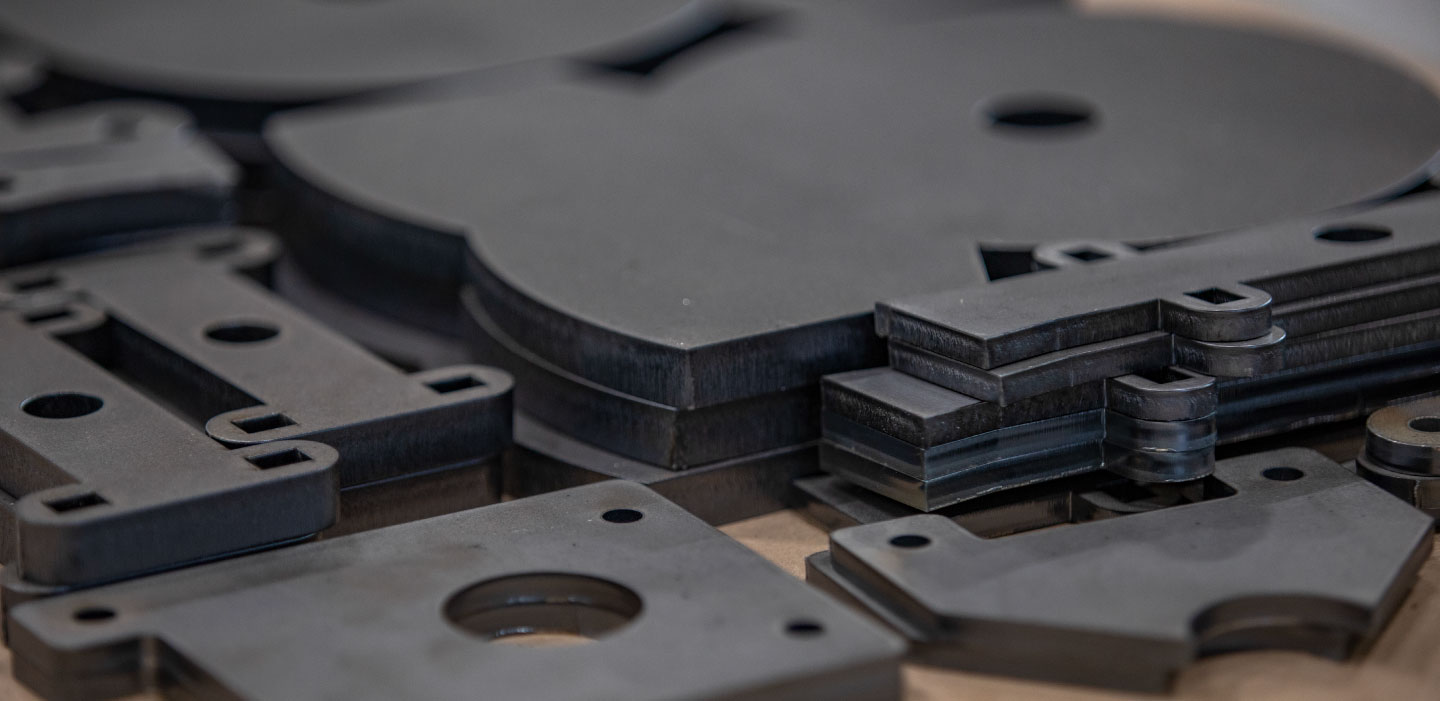
Laser cutting is well suited to low-volume metal fabrication because it does not require dedicated hard tooling for each new geometry. A digital part file drives the cutting process, allowing manufacturers to move from approved designs to production efficiently.
This can be particularly advantageous for relatively simple flat parts such as:
- Brackets
- Mounting plates
- Gussets
- Panels
- Covers
- Flanges
- Equipment components
- Structural plates
Eliminating dedicated tooling also makes design revisions easier to accommodate. When a hole location, outside profile, or other feature changes, the manufacturer can update the production file instead of modifying or replacing physical tooling.
Low Volume Does Not Always Equal Prototype Production
One important sourcing distinction is the difference between prototype capability and repeatable low-volume production.
A prototype proves that a part can be manufactured. Production requires the supplier to manufacture that part consistently across an entire order and subsequent releases.
Engineers and quality managers should therefore evaluate more than whether a fabrication shop accepts small jobs. Consider whether its equipment, quality controls, capacity, material sourcing, and workflow can support repeat orders.
For example, questions about first-article inspection, material traceability, documented inspection processes, equipment redundancy, and the ability to scale volume can help identify whether a laser cutting manufacturer is equipped for ongoing production.
That distinction becomes increasingly important when today’s 100-part requirement could become next year’s 1,000-part requirement.
Design Decisions Still Drive Part Cost
Low-volume manufacturing reduces certain barriers to production, but part design still has a direct impact on cost.
Tolerances are one area engineers should evaluate carefully. Specifying tighter tolerances than the application requires can make fabrication and inspection more demanding without improving part performance.
A more effective approach is to establish tolerances around functional requirements, mating features, assembly needs, and actual process capability. Tolerance decisions influence how reliably parts fit and how consistently they can be produced across batches.
Part geometry matters, too. Hole sizes, feature spacing, material thickness, edge requirements, and downstream operations should all be considered before releasing a drawing for production.
For simple laser-cut components, designs that align closely with the cutting process can help minimize unnecessary operations and keep the cost per part competitive.
Plan for the Production Run, Not Just the First Order
A successful low-volume sourcing strategy should account for what happens after the initial run.
Consider a manufacturer that needs 250 mounting plates for an equipment build. The initial order may be relatively small, but the same component could be reordered several times throughout the year.
Consistency between those releases is important.
Engineering and quality teams should confirm how the supplier handles drawing revisions, material specifications, inspection requirements, and production records. Buyers should also discuss expected annual usage and potential volume changes.
Providing this information during quoting gives the fabricator a better understanding of the complete program and can help determine the most efficient production approach.
When Should You Consider Low-Volume Metal Fabrication?
Low-volume metal fabrication can be a strong fit when:
- Annual demand does not justify a large inventory commitment
- A product is early in its production lifecycle
- Designs may require future revisions
- Parts are relatively simple and suitable for laser cutting
- Multiple configurations are needed in smaller quantities
- Replacement components need to be produced periodically
- Demand is expected to increase over time
The best production quantity ultimately depends on total program requirements. Engineers should evaluate part cost alongside tooling, inventory, lead time, quality, and the likelihood of future design changes.
Move From Low Volume to Repeat Production With SteinerZ
When your parts are ready to move beyond prototyping, you need a fabrication partner capable of producing consistent components today and supporting larger runs as demand grows.
SteinerZ provides precision CNC laser cutting and metal fabrication for prototypes through production runs. Its laser cutting capabilities support tolerances of ±.005″, while its ISO 9001:2015 quality management system supports consistent process control.
If you have a straightforward laser-cut part ready for low volume or repeat production, talk to SteinerZ about your project and request a quote.