Stainless steel is one of the most widely specified materials in manufacturing because of its strength, corrosion resistance, and long service life.
Those same properties that make stainless steel valuable also make it a material that demands precision during fabrication. For engineers and sourcing professionals, selecting the right cutting process directly affects part quality, downstream manufacturing, and overall production efficiency.
Here’s what engineers and fabrication buyers should know when specifying laser-cut stainless steel parts.
Why Laser Cutting Is Ideal for Stainless Steel
Stainless steel presents several fabrication challenges. It is harder than many carbon steels, generates significant heat during processing, and often requires clean cosmetic finishes or tight dimensional tolerances.
Modern fiber laser cutting systems overcome these challenges by concentrating a high-energy beam into a very small focal point, allowing the material to melt and be removed with exceptional precision.
Compared to traditional cutting methods, laser cutting offers several advantages:
- Extremely accurate profiles
- Clean, smooth cut edges
- Minimal heat-affected zones
- High repeatability across production runs
- Reduced material waste through optimized nesting
- Fast production speeds for both prototypes and production quantities
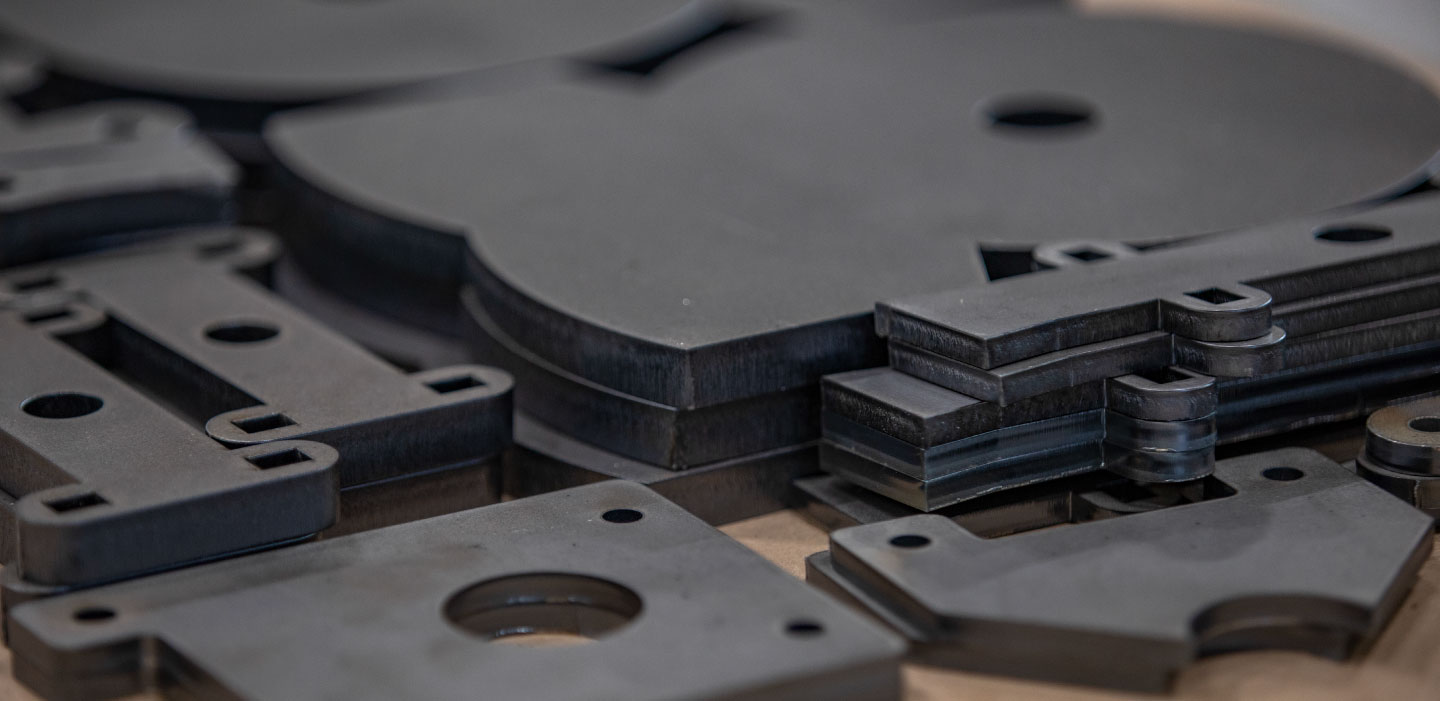
These advantages make laser cutting an excellent solution for flat stainless steel components that require precision from the first part through the last.
Common Stainless Steel Grades Used for Laser Cutting
Not every stainless steel alloy behaves exactly the same during fabrication. Material selection depends on the application’s environment, strength requirements, corrosion resistance, and cost objectives.
Some of the most commonly laser-cut grades include:
304 Stainless Steel
304 is one of the most frequently specified stainless steels across industries.
It offers:
- Excellent corrosion resistance
- Good formability
- Strong weldability
- Attractive surface finish
It is commonly used for:
- Food processing equipment
- Medical equipment housings
- Industrial machinery
- Architectural components
- Consumer products
316 Stainless Steel
316 contains molybdenum, providing enhanced corrosion resistance for harsh environments.
Typical applications include:
- Marine equipment
- Chemical processing
- Pharmaceutical manufacturing
- Outdoor equipment
- Coastal infrastructure
430 Stainless Steel
430 is often selected when corrosion resistance requirements are lower and cost savings are important.
Common applications include:
- Appliance components
- Decorative trim
- Automotive parts
- General industrial products
An experienced fabrication partner understands how each alloy responds to laser cutting and adjusts machine parameters accordingly to maintain edge quality and dimensional accuracy.
Design Considerations for Laser-Cut Stainless Steel Parts
Thoughtful part design helps maximize manufacturability while minimizing production costs, and engineers should consider a few different factors when designing parts for laser cutting.
Material Thickness
Laser cutting performs exceptionally well across a wide range of stainless steel sheet thicknesses. As thickness increases, cutting speed naturally decreases, and certain feature sizes may need to be adjusted.
Selecting the appropriate thickness should balance structural requirements with manufacturability and material cost.
Minimum Feature Size
Small holes, narrow slots, and intricate geometries require careful design. Features that are too small relative to the material thickness can become difficult to produce consistently.
Working with a fabrication partner during the design phase helps identify potential issues before production begins.
Inside Corners
Perfectly sharp internal corners are difficult to achieve with any cutting process.
Including appropriate corner radii improves cut quality while reducing stress concentrations in the finished part.
Part Nesting
Efficient nesting places multiple components on a single sheet to maximize material utilization.
Advanced nesting software helps reduce scrap, lower material costs, and improve production efficiency, particularly for high-volume orders.
How Laser Cutting Supports Better Part Quality
One of the biggest advantages of laser cutting stainless steel sheets is consistent part quality.
Modern CNC-controlled laser systems produce highly repeatable results with minimal variation between parts. This consistency becomes especially valuable during production runs where every component must fit correctly during welding, assembly, or final installation.
This level of precision reduces rework while simplifying downstream manufacturing processes.
High-quality laser cutting also provides:
- Smooth edges requiring little secondary finishing
- Accurate hole placement
- Consistent dimensional tolerances
- Reduced distortion from controlled heat input
- Reliable repeatability from prototype through production
Supporting Secondary Fabrication Processes
Laser cutting is often the first step in a larger fabrication process. After laser cutting, stainless steel parts may move into:
- CNC press brake forming
- Precision bending
- Welding and fabrication
- Hardware insertion
- Surface finishing
- Assembly
When parts begin with precise laser-cut geometry, forming operations become more predictable, weld fit-up improves, and final assemblies require less adjustment.
Working with a fabrication partner that provides multiple in-house capabilities can reduce lead times while maintaining quality throughout the manufacturing process.
Laser Cutting Offers Advanced Precision and Lead Time
For many manufacturers, the challenge is not simply producing quality parts. It is producing them consistently while meeting demanding production schedules.
Engineers often need:
- Rapid prototype iterations
- Small production batches
- High-volume manufacturing
- Repeat orders with identical quality
- Reliable delivery performance
Modern laser cutting technology supports all of these requirements through automated programming, CNC precision, and efficient production workflows.
This flexibility allows manufacturers to move from prototype to production without changing fabrication methods or sacrificing part quality.
Choosing the Right Stainless Steel Fabrication Partner
Equipment matters, but experience matters just as much.
A capable laser cutting partner should understand more than machine operation. They should also understand how design decisions, material selection, production scheduling, and downstream fabrication all influence the finished product.
When evaluating fabrication suppliers, consider factors such as:
- Experience with stainless steel fabrication
- Modern fiber laser cutting equipment
- Tight process control
- Efficient production planning
- In-house forming and secondary operations
- Consistent quality inspection
- Reliable lead times
A manufacturing partner that combines technical expertise with production efficiency can help reduce overall project costs while improving quality and delivery performance.
For projects that require precision stainless steel components, choosing the right fabrication partner often becomes just as important as selecting the right material.
Partner with SteinerZ for Precision Laser-Cut Stainless Steel Parts
SteinerZ combines advanced laser cutting technology with precision metal fabrication capabilities to help manufacturers produce consistent, high-quality parts while meeting demanding production schedules.
From efficient material utilization to dependable lead times, our team works closely with engineers and buyers to deliver components ready for the next stage of manufacturing.
To learn more about our capabilities, contact SteinerZ to discuss your next project and request a quote.