Faster Prototyping, Lower Costs, and Greater Flexibility
For engineers, product developers, and procurement teams, the challenge isn’t always finding a manufacturer that can produce thousands of parts. It’s finding one that can efficiently produce dozens, hundreds, or a few thousand high-quality components without excessive tooling costs or long lead times.
That’s where low-volume manufacturing metal services become a strategic advantage.
By combining precision laser cutting with flexible production workflows, manufacturers can bridge the gap between prototyping and full-scale production while maintaining quality, speed, and cost control.
What Is Low-Volume Metal Manufacturing?
Low-volume metal manufacturing refers to the production of metal parts in smaller quantities, typically ranging from a handful of prototypes to several thousand units. Unlike mass production, low-volume manufacturing prioritizes flexibility, shorter lead times, and reduced upfront investment.
For many industries, including industrial equipment, medical devices, electronics, transportation, and aerospace, low-volume production is essential for:
- Prototype development
- Product testing and validation
- Pilot production runs
- Replacement parts
- Custom equipment components
- Market-entry product launches
Modern laser cutting technology has become one of the most effective methods for producing these parts because it eliminates many of the costs associated with traditional tooling and stamping processes.
Why Laser Cutting Is Ideal for Low-Volume Metal Production
When producing smaller quantities of metal parts, investing in hard tooling often doesn’t make financial sense. Laser cutting provides a highly efficient alternative.
No Tooling Costs
Traditional manufacturing methods such as stamping require custom dies and tooling that can cost thousands, or even tens of thousands, of dollars before production begins.
Laser cutting operates directly from CAD files, allowing manufacturers to begin production immediately without tooling investments.
This makes laser cutting particularly valuable for:
- Product development projects
- Design revisions
- Custom components
- Limited production runs
Faster Lead Times
Speed is often critical during product development and launch phases.
Because laser-cut parts require minimal setup, manufacturers can move quickly from design approval to production. Engineering teams can receive parts faster, evaluate performance, and make design changes without waiting for new tooling to be produced.
For organizations operating under tight project schedules, this agility can significantly reduce time-to-market.
Design Flexibility
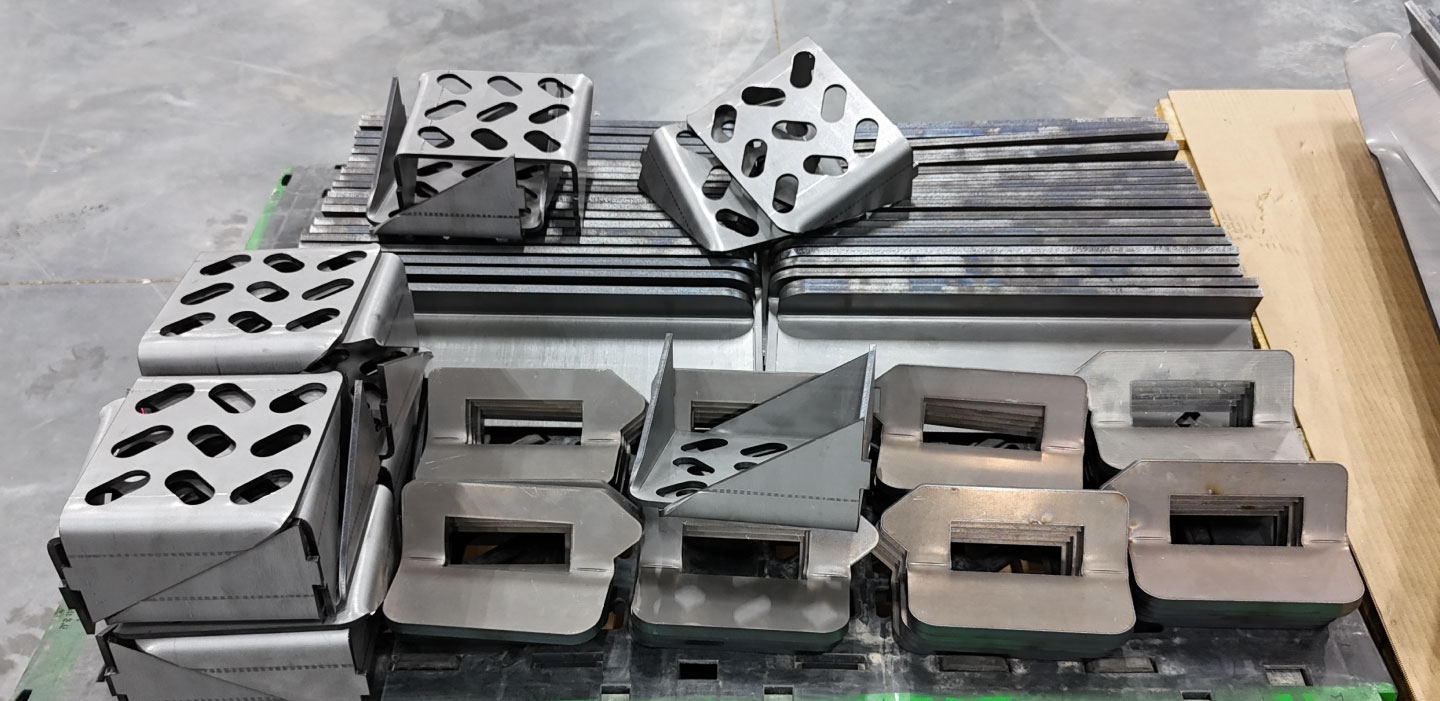
One of the biggest advantages of laser cutting is the ability to accommodate complex geometries.
These features can be produced directly from digital designs:
- Intricate cutouts
- Tight tolerances
- Small holes
- Detailed patterns
- Custom shapes
can be produced directly from digital designs.
If modifications are needed, engineers simply update the CAD file rather than purchasing new tooling, making iterative design improvements more practical and cost-effective.
Materials Commonly Used in Low-Volume Laser Cutting
A wide variety of metals can be processed through laser cutting systems, allowing manufacturers to meet diverse performance requirements.
Common materials include:
- Carbon steel
- Stainless steel
- Aluminum
- Galvanized steel
- Copper
- Brass
Material selection depends on factors such as corrosion resistance, strength requirements, weight considerations, conductivity, and end-use environment.
For engineering teams evaluating manufacturability, working with a fabrication partner that understands material behavior can help optimize both performance and production costs.
When You Should Choose Low-Volume Manufacturing
Many buyers assume high-volume production is always the most economical option. In reality, low-volume manufacturing often delivers greater value in specific situations.
Product Development and Prototyping
Engineering teams frequently need multiple iterations before finalizing a design.
Laser cutting allows manufacturers to quickly produce revised components without requiring expensive tooling modifications.
This supports faster testing cycles and reduces development risk.
Bridge Production
Many companies need parts while waiting for full-scale production tooling to be completed.
Low-volume manufacturing serves as an effective bridge strategy, allowing products to enter the market sooner while long-term manufacturing solutions are finalized.
Custom and Specialized Products
Some products simply don’t require mass production volumes.
Industries with specialized equipment, custom machinery, or highly engineered assemblies often benefit from ongoing low-volume production because it aligns with actual demand while minimizing inventory costs.
Quality Considerations for Low-Volume Metal Manufacturing
Low-volume production should never mean lower quality.
Advanced laser cutting systems deliver:
- High dimensional accuracy
- Consistent edge quality
- Repeatable tolerances
- Minimal material distortion
When paired with secondary fabrication processes such as bending, welding, machining, and finishing, manufacturers can produce production-ready components that meet demanding engineering specifications.
Choosing the Right Low-Volume Manufacturing Partner
Not all fabrication providers are optimized for low-volume production.
When evaluating a manufacturing partner, buyers should look for:
- Modern laser cutting equipment
- Engineering support
- Material expertise
- Fast quoting capabilities
- Secondary fabrication services
- Scalable production capacity
The ideal partner can support projects from prototype through production, eliminating the need to transition suppliers as demand grows.
This continuity improves communication, maintains quality standards, and reduces supply chain complexity.
How SteinerZ Supports Low-Volume Metal Manufacturing
At SteinerZ, we help engineers and procurement teams accelerate product development through precision laser cutting and custom metal fabrication services.
Our low-volume manufacturing capabilities allow customers to:
- Reduce upfront production costs
- Accelerate development timelines
- Improve design flexibility
- Maintain tight tolerances
- Scale production as demand increases
Whether you need a small batch of laser-cut components or a bridge production solution before full-scale manufacturing, our team delivers precision, responsiveness, and manufacturing expertise throughout the process.